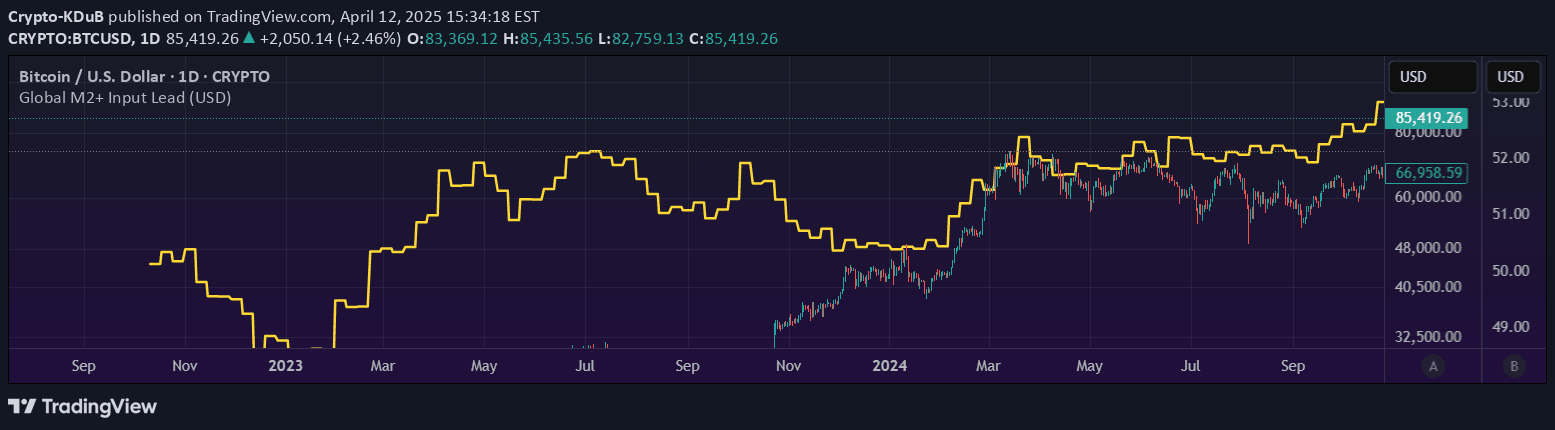
M2 Global Money Supply tracks total money circulation across nations, providing insights into economic liquidity and potential market trends through comprehensive monetary analysis.
Explore complementary indicator rolesHow it works
M2 Global Money Supply calculates the total money in circulation, including cash, checking deposits, savings accounts, and money market securities across multiple countries. The metric aggregates different monetary components to provide a comprehensive view of liquid assets available in global financial systems.
Economists and traders analyze these figures by comparing current money supply levels with historical data, tracking percentage changes, and examining trends across different national economies. The comprehensive dataset helps identify potential economic shifts and monetary policy implications.
Why it may be useful
M2 Global Money Supply serves as a critical economic indicator revealing the overall liquidity and potential inflationary pressures within global financial markets. By tracking the total money in circulation, traders and investors can gain insights into potential economic expansions, contractions, and monetary policy directions.
Understanding these monetary trends helps investors make more informed decisions about asset allocation, currency movements, and potential market reactions. The metric provides a macroeconomic perspective that can signal broader economic trends beyond individual market performances.
When to explore it
M2 Global Money Supply is most effective when analyzing long-term economic trends and potential market shifts across multiple national economies. Traders and investors should utilize this metric during periods of significant economic uncertainty or when assessing potential global economic transformations.
The indicator becomes particularly valuable when comparing monetary policies between different countries, evaluating potential currency movements, and understanding broader economic cycles. It is most suitable for strategic, long-term investment approaches rather than short-term trading strategies.
Keep exploring
What we’ve verified
Access, alerts and repainting behaviour have not been independently verified for this indicator. Check the creator’s current publication and settings.
General descriptions and classifications are recovered research. Verified details above identify the specific checks we have completed. Check the creator’s current publication for later changes.