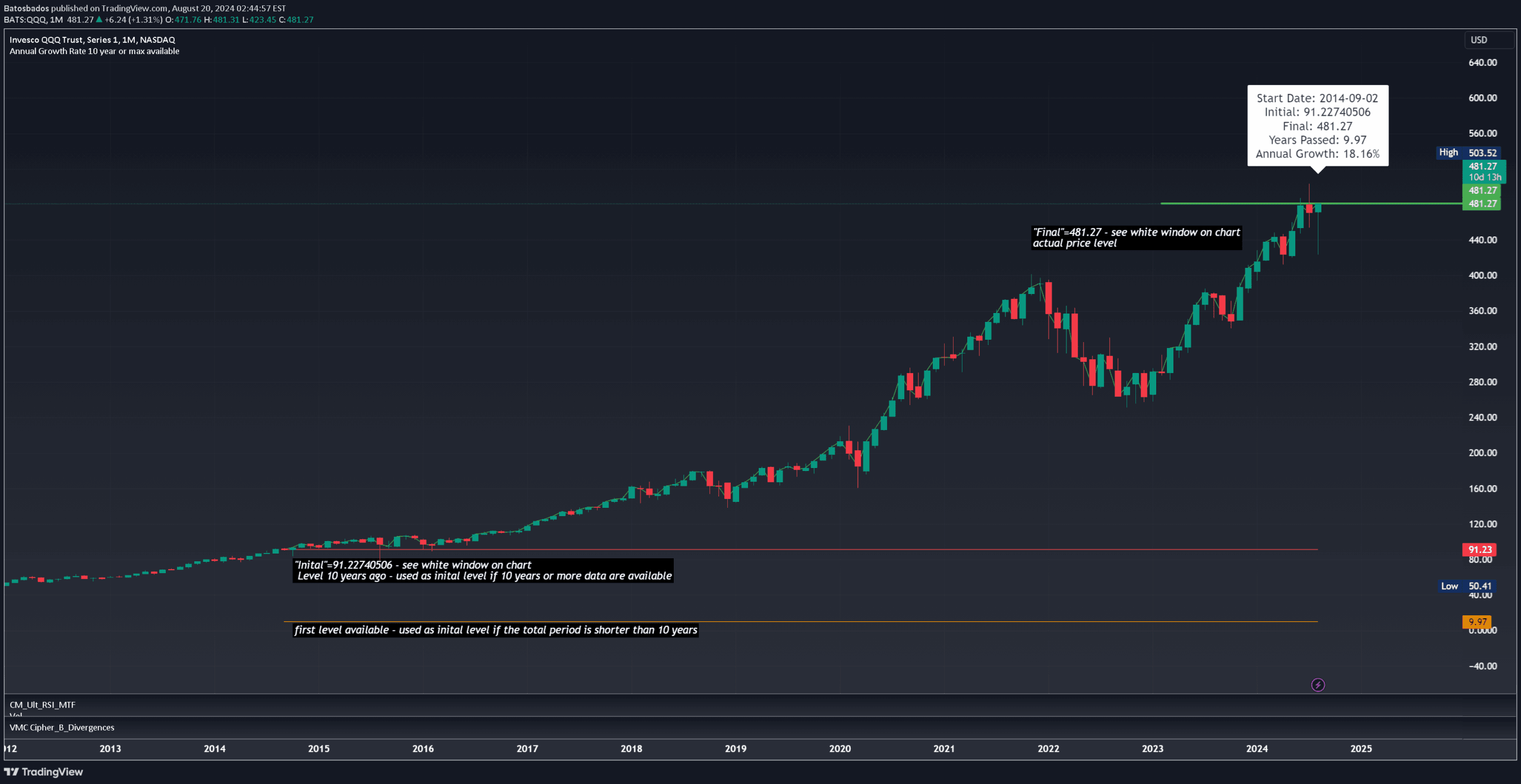
A tool for calculating Compound Annual Growth Rate (CAGR) over a 10-year period to assess the long-term growth potential of investment assets.
Explore complementary indicator rolesHow it works
The CAGR calculation begins by identifying the starting and ending values of an asset over a 10-year period or the maximum available historical data. It uses a mathematical formula that determines the smoothed annualized return, accounting for the compounding effect of investment growth.
By analyzing the total percentage change in value and converting it to an annualized rate, the indicator provides a standardized measure of investment performance. This allows investors to compare different assets on an equivalent basis, regardless of their specific price movements or investment durations.
Why it may be useful
The CAGR provides investors with a clear, simplified metric to understand long-term investment performance beyond simple point-to-point returns. It smooths out volatility and gives a more accurate representation of an asset's growth potential over time.
By presenting a single, annualized percentage, CAGR enables investors to make more informed decisions about asset allocation, compare different investment opportunities, and assess the historical effectiveness of various financial instruments.
When to explore it
CAGR is most effective when analyzing long-term investment strategies and comparing the performance of different assets across extended time horizons. It is particularly useful for evaluating stocks, mutual funds, ETFs, and other investment vehicles with significant historical data.
Investors should use CAGR when seeking to understand sustained growth potential, making strategic investment decisions, and conducting comprehensive portfolio analysis. It is especially valuable for retirement planning, long-term wealth management, and comparing investments with varying risk profiles.
Keep exploring
What we’ve verified
Access, alerts and repainting behaviour have not been independently verified for this indicator. Check the creator’s current publication and settings.
General descriptions and classifications are recovered research. Verified details above identify the specific checks we have completed. Check the creator’s current publication for later changes.