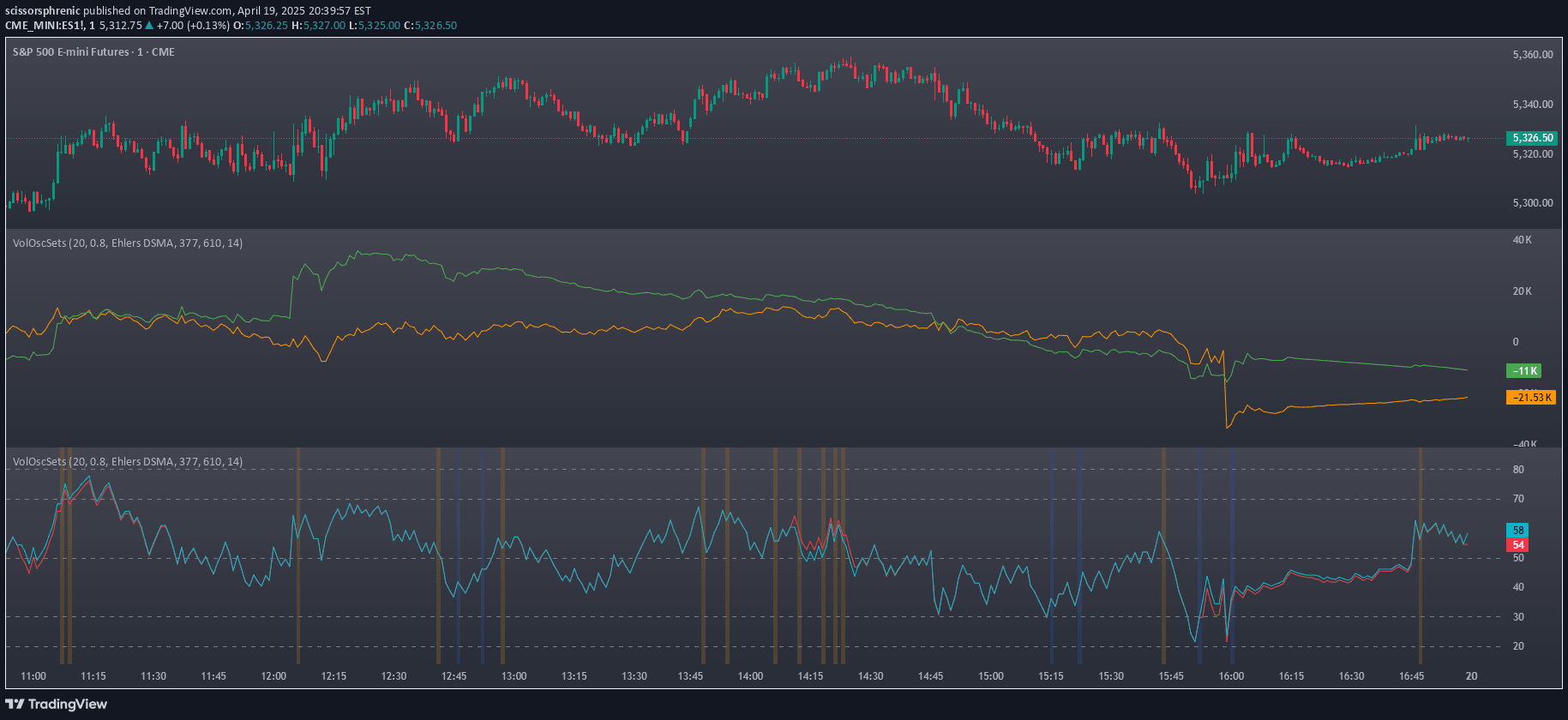
A volume-based indicator that calculates the percentage difference between up and down days, helping traders understand buying and selling power in the market.
Explore complementary indicator rolesHow it works
The indicator calculates volume-weighted percentage changes by identifying up and down days based on price closing relative to the average of high, low, and close prices. An up day is defined when the price closes above the average, while a down day is when the price closes below this average.
The cumulative difference percentage is then visualized through a histogram with two exponential moving averages (EMAs). This approach allows traders to see the ongoing balance between buying and selling pressure across different time periods.
Why it may be useful
This indicator provides traders with a nuanced view of market sentiment by quantifying the strength of buying and selling activities. By analyzing volume-weighted price movements, it offers insights into potential trend shifts and market dynamics that might not be immediately apparent from price action alone.
The histogram and EMA visualization help traders quickly assess whether bulls or bears are currently dominating the market, enabling more informed trading decisions and potential entry or exit points.
When to explore it
The indicator is most effective in markets with clear directional movements and significant volume trading. It works best for active traders who need to quickly assess market sentiment and potential momentum shifts during the trading day.
Traders should use this tool in conjunction with other technical indicators to confirm signals and minimize false interpretations. It is particularly useful in volatile markets where rapid changes in buying and selling pressure can signal potential trend reversals or continuation.
Keep exploring
What we’ve verified
Access, alerts and repainting behaviour have not been independently verified for this indicator. Check the creator’s current publication and settings.
General descriptions and classifications are recovered research. Verified details above identify the specific checks we have completed. Check the creator’s current publication for later changes.