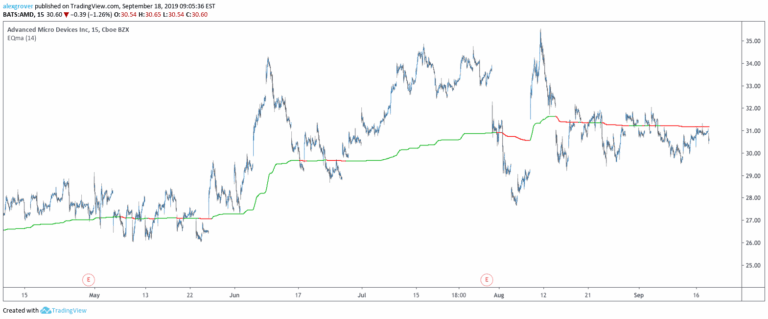
HADES is an adaptive exponential smoothing method for high-frequency time series data, providing advanced forecasting and adaptive trend analysis with minimal parameter requirements.
Explore complementary indicator rolesHow it works
HADES uses a hybrid adaptive double exponential smoothing technique that dynamically calculates smoothing parameters directly from the input data. It applies a recursive formula where the current value is estimated using an adaptive alpha parameter calculated based on data length and signal consistency.
The method first computes a level component (a) and a trend component (b) using an innovative adaptive alpha formula. It then generates forecasts by incorporating these components, allowing for one-point predictions and interval estimations with minimal computational complexity.
Why it may be useful
HADES offers a data-driven approach to time series forecasting that eliminates subjective parameter tuning and provides adaptive insights across various data streams. Its recursive nature enables real-time processing of high-frequency data with consistent performance across different signal characteristics.
By leveraging fractal efficiency and sophisticated mathematical transformations, HADES can capture underlying trends and provide robust predictions with minimal computational overhead. This makes it particularly valuable for traders and analysts seeking flexible, responsive forecasting methods.
When to explore it
HADES is most effective when analyzing high-frequency, streaming time series data such as tick charts, orderbook information, and sensor readings. It performs exceptionally well in scenarios requiring rapid, adaptive trend detection with minimal latency and parameter optimization.
The method is particularly suited for environments with dynamic, rapidly changing data patterns where traditional smoothing techniques might struggle. Traders can utilize HADES for nowcasting, detecting significant deviations, and understanding potential future data point emergence.
Keep exploring
What we’ve verified
Access, alerts and repainting behaviour have not been independently verified for this indicator. Check the creator’s current publication and settings.
General descriptions and classifications are recovered research. Verified details above identify the specific checks we have completed. Check the creator’s current publication for later changes.