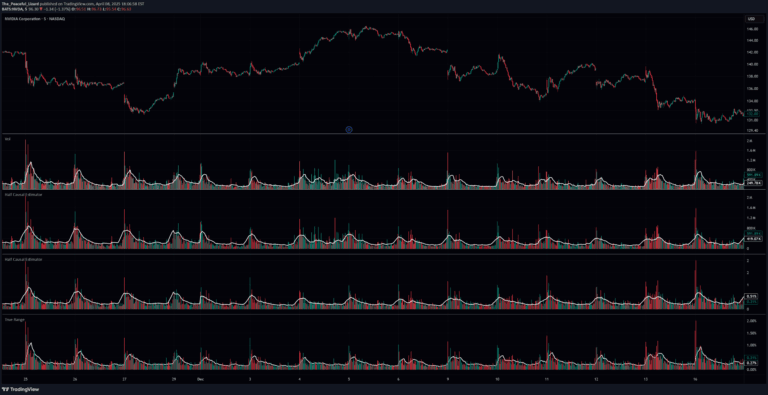
A modified MACD indicator that normalizes momentum using Average True Range, providing a more adaptive approach to identifying trend shifts and market momentum across different volatility conditions.
Explore complementary indicator rolesHow it works
The MACD-V first calculates the traditional Moving Average Convergence Divergence (MACD) by subtracting the long-term exponential moving average from the short-term exponential moving average. It then introduces a unique volatility normalization step using the Average True Range (ATR), which adjusts the MACD line to account for market volatility.
By scaling the MACD line with ATR, the indicator creates a more standardized momentum measure that can be compared across different market conditions and instruments. The normalized MACD is then plotted alongside a signal line, with crossovers and histogram differences providing visual cues about potential trend changes and momentum strength.
Why it may be useful
Traditional MACD indicators can provide misleading signals during periods of high or low volatility, as the raw momentum values may not accurately reflect the true market dynamics. The MACD-V addresses this limitation by incorporating volatility normalization, which allows traders to make more informed decisions based on a more consistent and adaptable momentum metric.
By adjusting the MACD line using ATR, the indicator helps traders better understand momentum shifts across different market environments, reducing the risk of false signals and providing a more nuanced view of trend strength and potential reversals.
When to explore it
The MACD-V is most effective in markets with varying volatility levels, such as forex, stocks, and cryptocurrencies. Traders can use this indicator during trending and range-bound market conditions to identify potential entry and exit points, with the normalized momentum providing clearer signals compared to traditional MACD approaches.
It is particularly useful for traders who want a more adaptive momentum indicator that can adjust to changing market conditions. The customizable parameters allow traders to fine-tune the indicator to their specific trading style, timeframe, and market characteristics.
Keep exploring
What we’ve verified
Access, alerts and repainting behaviour have not been independently verified for this indicator. Check the creator’s current publication and settings.
General descriptions and classifications are recovered research. Verified details above identify the specific checks we have completed. Check the creator’s current publication for later changes.