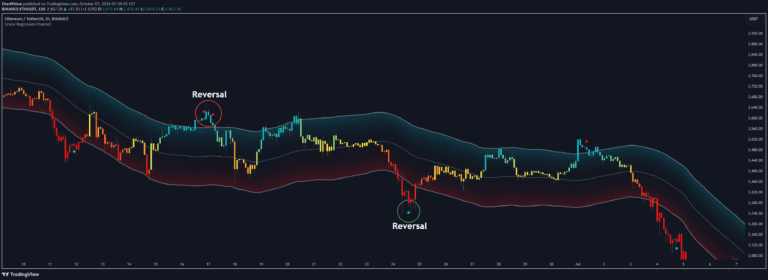
A novel moving average technique that reduces lag by projecting price movement using linear regression, helping traders identify trend shifts more responsively.
Explore complementary indicator rolesHow it works
The Projected Moving Average (PMA) calculates a moving average with reduced lag by incorporating the linear regression slope of price data. It first computes a standard Simple Moving Average (SMA) and then adjusts it using the slope of price movement, effectively shifting the average forward in time.
The technique involves calculating the slope through covariance between prices and sample points, then adding this slope across half the data length to the SMA. This creates a first-order prediction that substantially reduces the inherent lag in traditional moving averages, making the indicator more responsive to price changes.
Why it may be useful
Traditional moving averages often lag behind price movements, causing traders to miss critical entry and exit points. The PMA addresses this limitation by dynamically projecting the average's position, providing a more accurate representation of current market trends and potential directional shifts.
By reducing lag, traders can make more timely decisions, potentially capturing more of a trend's initial movement. The indicator's ability to predict and visualize trend changes can help traders react more quickly to market dynamics, improving potential trade timing and reducing the risk of entering or exiting positions too late.
When to explore it
The PMA works best in markets with clear trending characteristics, where price movement demonstrates consistent directional momentum. It is particularly effective in identifying trend transitions early, making it valuable for traders seeking to capture the beginning of new trend cycles across various timeframes.
Traders should combine the PMA with other technical indicators to confirm signals and reduce false positives. It is most reliable in liquid markets with sufficient price data, such as major stock indices, forex pairs, and actively traded commodities. The indicator's versatility allows it to be applied across different trading styles, from short-term scalping to longer-term swing trading.
Keep exploring
What we’ve verified
Access, alerts and repainting behaviour have not been independently verified for this indicator. Check the creator’s current publication and settings.
General descriptions and classifications are recovered research. Verified details above identify the specific checks we have completed. Check the creator’s current publication for later changes.