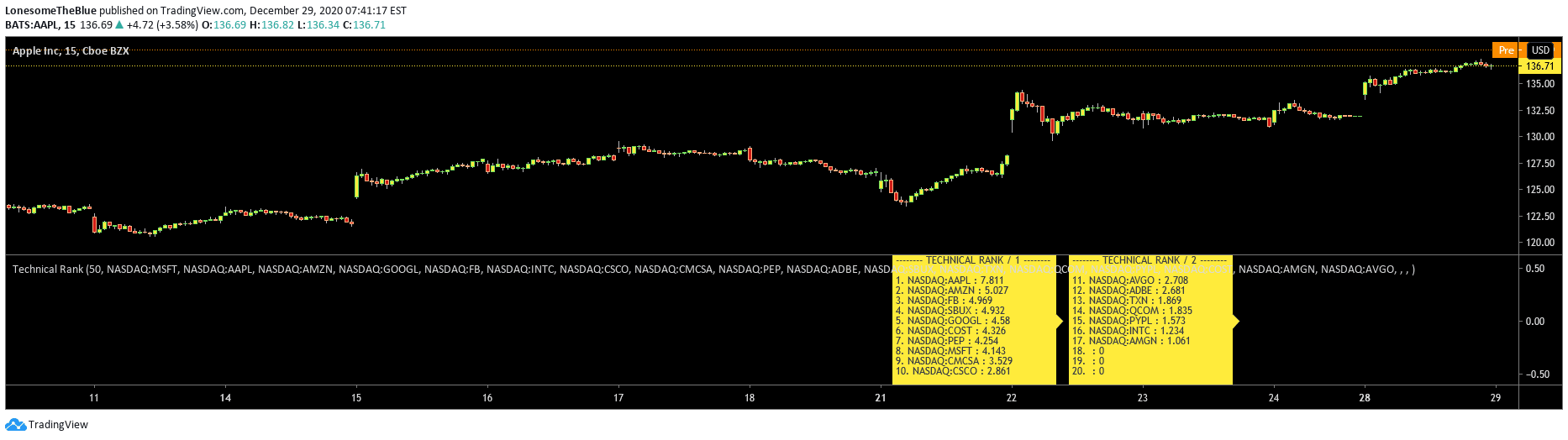
Technical Rank evaluates a security's performance by analyzing multiple indicators across long, medium, and short-term timeframes, providing a comprehensive ranking of technical strength.
Explore complementary indicator rolesHow it works
Technical Rank calculates a security's performance using a weighted combination of indicators. Long-term analysis includes 200-day exponential moving average and 125-day rate of change, each weighted at 30%. Medium-term indicators use 50-day EMA and 20-day rate of change at 15% each.
Short-term components involve the percentage price oscillator histogram and relative strength index, each weighted at 5%. The resulting score ranges from 0 to 100, with higher values indicating stronger technical performance relative to peer securities
Why it may be useful
Technical Rank provides traders with a comprehensive, multi-dimensional view of a security's performance. By combining different timeframe indicators, it offers a more nuanced assessment than single-indicator analysis. The ranking helps identify potentially strong and weak securities within a group, guiding investment decisions.
Traders can quickly compare multiple securities and focus on those showing consistent technical strength. This approach reduces subjective interpretation and provides a systematic method for screening and selecting investment opportunities
When to explore it
Technical Rank works best when analyzing a group of similar securities within the same market category, such as stocks, cryptocurrencies, or forex pairs. It is most effective for swing traders looking to identify relatively strong performers over multiple timeframes.
The indicator is particularly useful during market transitions or when seeking to compare securities within a specific sector or index. Traders should use it as part of a broader analysis strategy, combining it with fundamental research and other technical indicators
Keep exploring
What we’ve verified
Access, alerts and repainting behaviour have not been independently verified for this indicator. Check the creator’s current publication and settings.
General descriptions and classifications are recovered research. Verified details above identify the specific checks we have completed. Check the creator’s current publication for later changes.