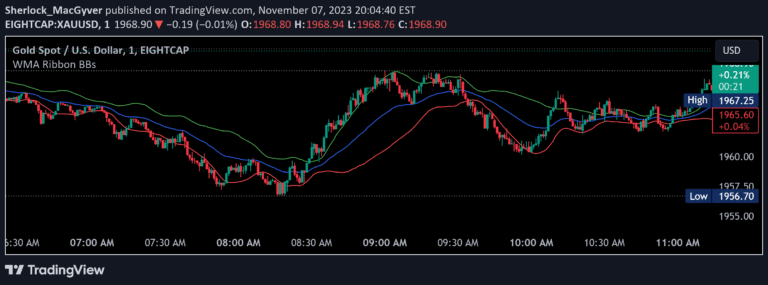
A Bollinger Bands-based indicator that identifies choppy market conditions by measuring price movement within bands, helping traders recognize periods of low volatility and potential trading challenges.
Explore complementary indicator rolesHow it works
The Choppy Market Identifier uses Bollinger Bands, which consist of a middle simple moving average (SMA) line and two outer bands plotted two standard deviations away. The indicator tracks how frequently the closing price remains within these bands during a specific period. By calculating the percentage of time the price stays inside the bands, it determines market choppiness.
When the price remains within the Bollinger Bands for more than 80% of the analyzed timeframe, the market is considered choppy. This suggests low volatility and uncertain price direction, making it challenging for traders to identify clear trading opportunities. The indicator visually highlights these conditions by changing the chart's background color.
Why it may be useful
Understanding market choppiness is crucial for traders as it helps prevent entering trades during periods of low directional movement. In choppy markets, price movements are erratic and lack clear trend, which can lead to false signals and potential losses. Recognizing these conditions allows traders to avoid unnecessary risk and wait for more favorable trading environments.
The Choppy Market Identifier provides a systematic approach to evaluating market conditions, helping traders make more informed decisions. By distinguishing between trending and non-trending markets, traders can adjust their strategies, reduce potential losses, and improve overall trading performance.
When to explore it
The Choppy Market Identifier is most effective when used alongside other technical analysis tools to confirm market conditions. Traders should be cautious when the indicator suggests a choppy market, as this signals potential difficulty in executing profitable trades. It is particularly useful in volatile or range-bound markets where price movements lack clear direction.
Ideal usage includes combining this indicator with trend-following or momentum indicators to validate trading signals. During choppy market periods, traders might consider reducing position sizes, avoiding new entries, or switching to range-trading strategies that capitalize on price oscillations within defined boundaries.
Keep exploring
What we’ve verified
Access, alerts and repainting behaviour have not been independently verified for this indicator. Check the creator’s current publication and settings.
General descriptions and classifications are recovered research. Verified details above identify the specific checks we have completed. Check the creator’s current publication for later changes.