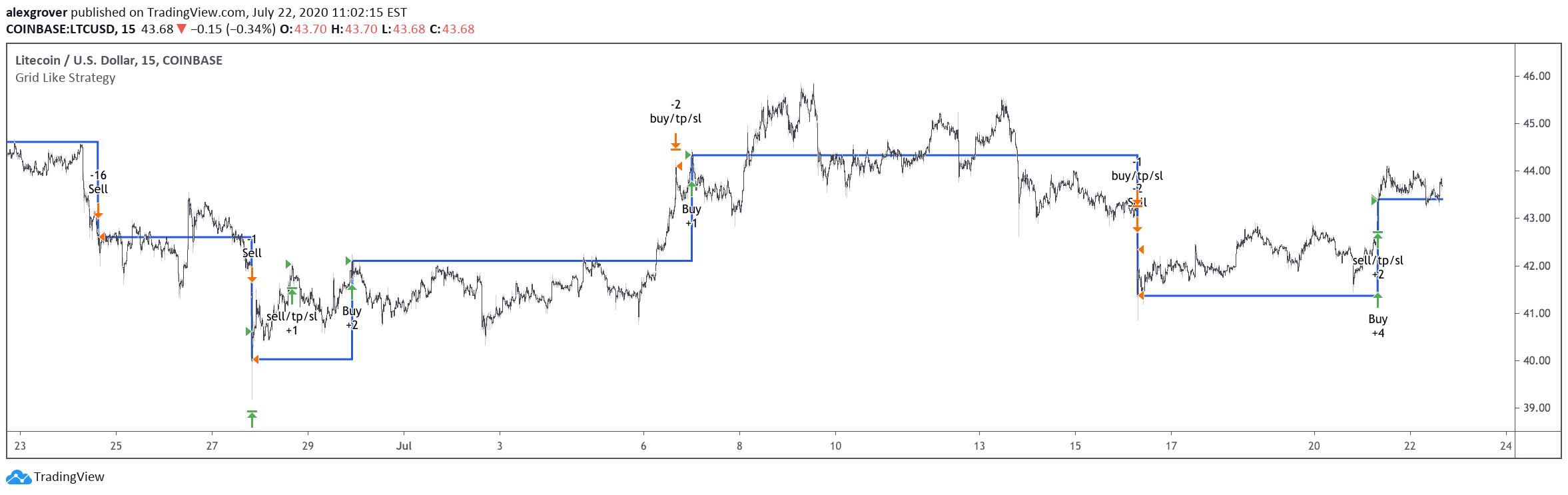
A grid trading strategy using martingale position sizing that doubles position size after losses, aiming to recover from previous trades by increasing exposure with each unsuccessful trade.
Explore complementary indicator rolesHow it works
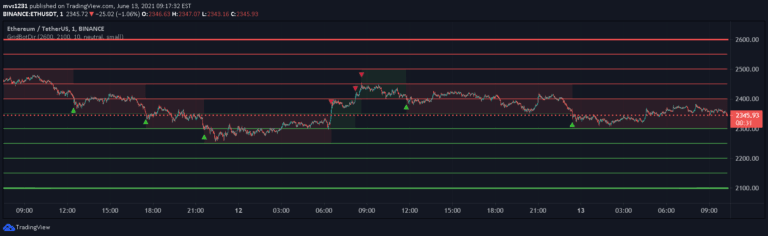
The grid trading strategy involves creating equally spaced price levels where trades are executed. When price crosses a level, a trade is opened with a take profit at the next higher level and a stop loss at the next lower level.
The martingale component doubles the position size after each loss, theoretically allowing recovery of previous losses. This approach assumes consistent market behavior and equal probabilities of winning and losing trades across preset grid levels
Why it may be useful
Martingale grid strategies attract traders seeking systematic approaches to recover losses and potentially generate consistent returns. They offer a structured method for trade entry and exit based on predefined price levels.
However, the strategy carries significant risks due to exponential position sizing, which can rapidly deplete trading capital. Understanding its limitations is crucial for preventing catastrophic trading failures and managing risk effectively
When to explore it
This strategy works best in range-bound or low-volatility markets with predictable price movements. It is most suitable for traders with substantial capital reserves and high risk tolerance.
Cryptocurrency markets, which trade continuously, might provide more favorable conditions. Traders should carefully backtest and simulate the strategy under various market conditions, paying close attention to transaction costs, potential slippage, and maximum drawdown scenarios
Keep exploring
What we’ve verified
Access, alerts and repainting behaviour have not been independently verified for this indicator. Check the creator’s current publication and settings.
General descriptions and classifications are recovered research. Verified details above identify the specific checks we have completed. Check the creator’s current publication for later changes.