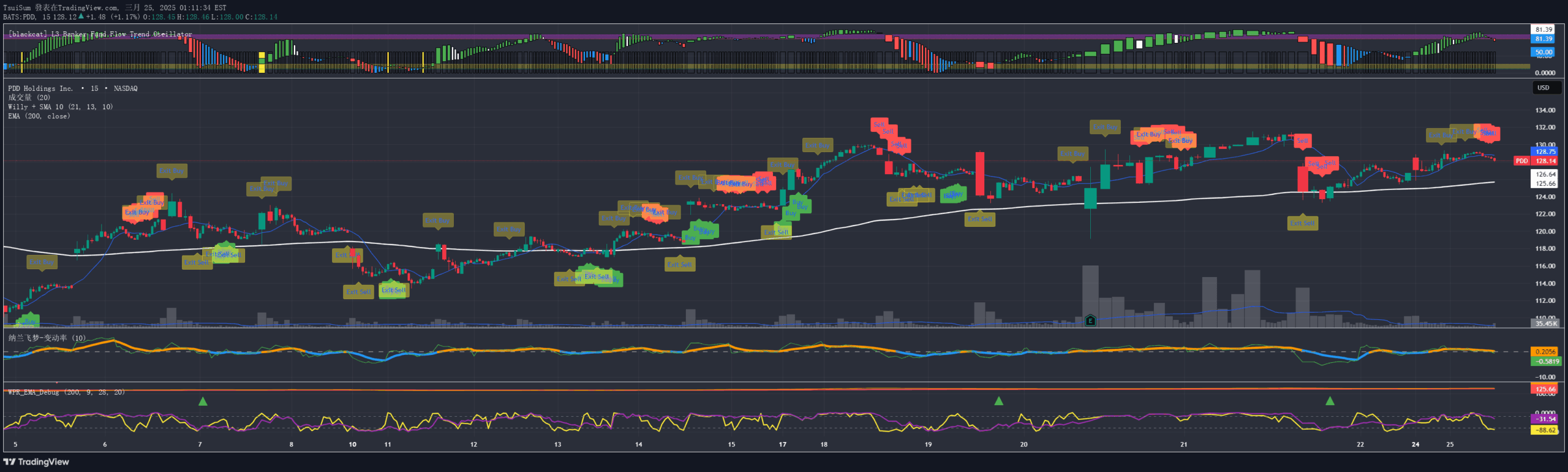
A trading strategy using 200-period EMA and dual Williams %R indicators to identify market trends and potential reversal points for strategic entry and exit decisions.
Explore complementary indicator rolesHow it works
The strategy first uses the 200-period Exponential Moving Average (EMA) to determine the market's overall trend direction by comparing current price to the EMA line. When price is above the 200-period EMA, the market is considered bullish, and traders seek buying opportunities; when price is below, the market is considered bearish, and traders look for selling opportunities.
The strategy then employs two Williams %R indicators with different periods (9 and 28) to identify potential reversal points. When both WPR indicators cross specific thresholds, they generate trading signals: in an uptrend, a signal occurs when both cross above -80, and in a downtrend, a signal happens when both cross below -20.
Why it may be useful
This strategy provides traders with a structured approach to trend identification and entry timing by combining trend analysis with momentum indicators. By using the 200-period EMA, traders can objectively determine market direction, reducing emotional decision-making and providing a clear framework for potential trade opportunities.
The dual Williams %R indicators add an additional layer of confirmation, helping traders identify potential reversal points with greater confidence. This approach minimizes false signals by requiring both indicators to meet specific conditions, which can help improve the overall accuracy of trading decisions and reduce unnecessary risk.
When to explore it
This strategy is most effective in markets with clear trending characteristics, where prices are moving consistently in one direction for extended periods. It works particularly well in liquid markets with sufficient price movement, such as major currency pairs, stock indices, and high-volume commodities.
Traders should be cautious during periods of market consolidation or extreme volatility, as the strategy's signals may be less reliable. The approach is best suited for traders who prefer a systematic, trend-following method with built-in momentum confirmation, and who are willing to wait for clear, validated entry points before executing trades.
Keep exploring
What we’ve verified
Access, alerts and repainting behaviour have not been independently verified for this indicator. Check the creator’s current publication and settings.
General descriptions and classifications are recovered research. Verified details above identify the specific checks we have completed. Check the creator’s current publication for later changes.