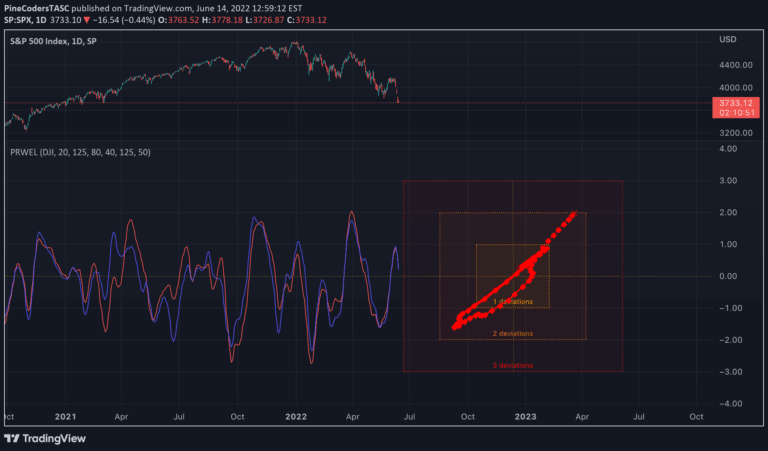
A sophisticated signal processing technique that identifies dominant market cycles by applying linear predictive filters to price data, helping traders adapt strategies to changing market conditions.
Explore complementary indicator rolesHow it works
The signal uses digital signal processing techniques to analyze price data as a complex time series. It applies highpass and lowpass filters to isolate specific frequency ranges in market data. A linear predictive filter then calculates coefficients that minimize prediction errors.
The method transforms price data into the frequency domain, revealing cyclic components. It adaptively estimates the data's structure by adjusting filter coefficients. The process helps identify the dominant market cycle by comparing different frequency components
Why it may be useful
Traditional technical indicators often use static parameters that fail to adapt to changing market conditions. This signal processing approach dynamically adjusts to market rhythms, providing more responsive insights. It helps traders understand underlying market cycles more precisely.
The technique can improve timing of entries and exits by revealing hidden periodic patterns. It offers a scientific, data-driven approach to market analysis. Traders can use the dominant cycle information to tune other indicators more effectively
When to explore it
This signal works best in markets with clear cyclical behaviors, such as stocks, commodities, and forex. It is particularly useful for swing traders seeking to capture multi-day price movements. The technique is most effective when market data shows repeating patterns or wavelike characteristics.
Traders should use it alongside other trend and momentum indicators for confirmation. It performs well in markets with consistent periodic fluctuations. The signal is less effective in highly random or news-driven market environments
Keep exploring
What we’ve verified
Access, alerts and repainting behaviour have not been independently verified for this indicator. Check the creator’s current publication and settings.
General descriptions and classifications are recovered research. Verified details above identify the specific checks we have completed. Check the creator’s current publication for later changes.