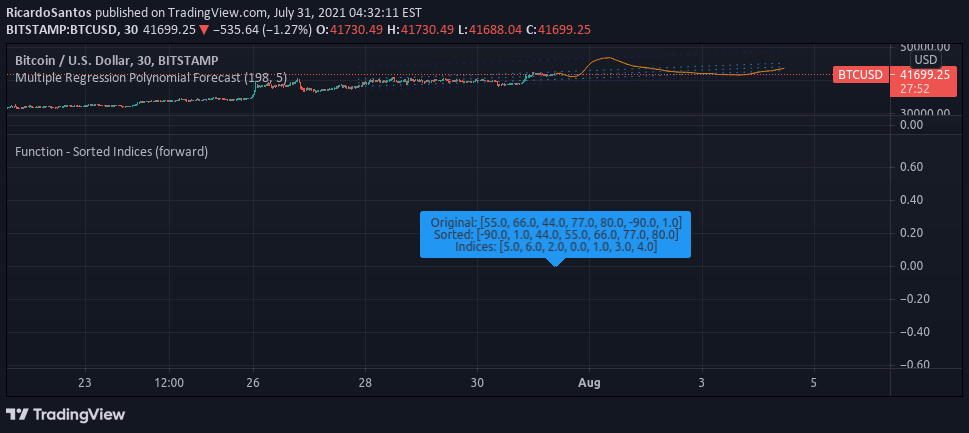
A function that sorts indices in an array using bubble sort algorithm, providing a method to organize and arrange data elements based on their values from lowest to highest.
Explore complementary indicator rolesHow it works
Bubble sort works by repeatedly stepping through the list, comparing adjacent elements and swapping them if they are in the wrong order. The algorithm passes through the list multiple times, progressively moving the largest unsorted element to its correct position at the end of the array.
In each iteration, the algorithm compares each pair of adjacent elements and swaps them if they are in the incorrect sequence. This process continues until no more swaps are needed, indicating the entire list is sorted
Why it may be useful
Bubble sort provides a straightforward method for sorting data, which is crucial in various computational tasks and algorithmic operations. It serves as an intuitive introduction to sorting algorithms, helping developers understand basic comparison and swapping techniques.
While not the most efficient for large datasets, it remains valuable for small lists and educational purposes. The algorithm's simplicity makes it easy to implement and understand, serving as a foundational concept in computer science and data manipulation
When to explore it
Bubble sort is most appropriate for small datasets or educational demonstrations where computational efficiency is not a primary concern. It works best with lists containing a limited number of elements, typically less than 50 items.
The algorithm is particularly useful when teaching sorting concepts to beginners or when implementing simple sorting mechanisms in non-performance-critical applications. For larger datasets or time-sensitive operations, more advanced sorting algorithms like quicksort or merge sort are recommended
Keep exploring
What we’ve verified
Access, alerts and repainting behaviour have not been independently verified for this indicator. Check the creator’s current publication and settings.
General descriptions and classifications are recovered research. Verified details above identify the specific checks we have completed. Check the creator’s current publication for later changes.