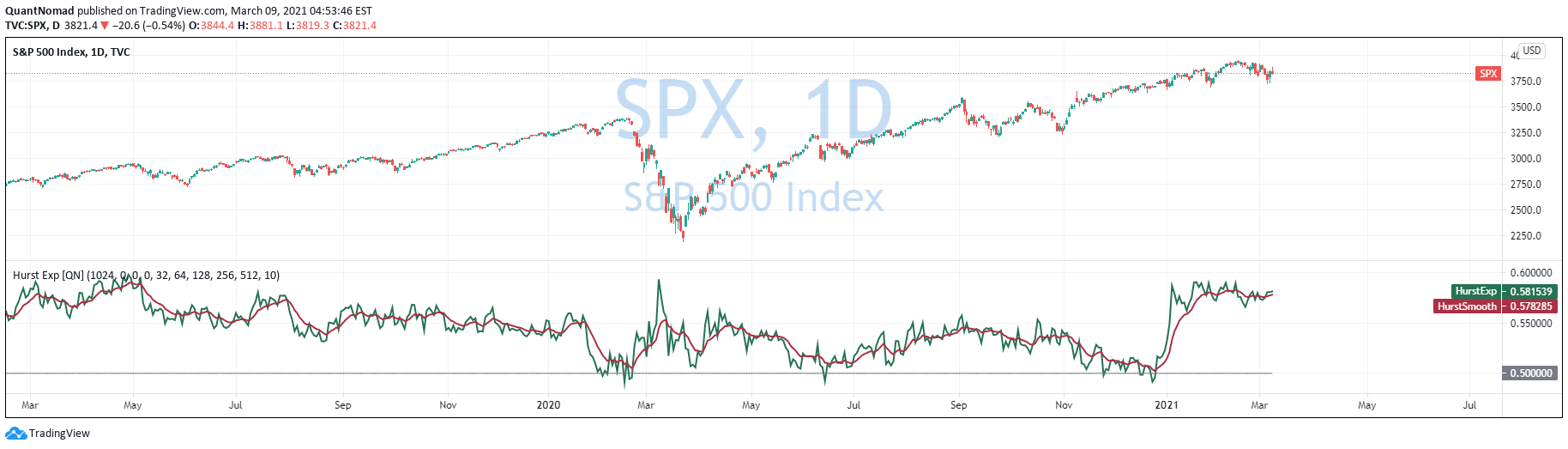
The Hurst Exponent is a statistical measure that evaluates time series behavior, helping traders identify market trends, mean reversion, and potential future price movements.
Explore complementary indicator rolesHow it works
The Hurst Exponent calculates long-term memory of time series by analyzing autocorrelations across different time intervals. It involves splitting a lookback period into multiple shorter samples and computing the rescaled range (R/S) for each sample size.
By plotting logarithmic values of sample sizes against their corresponding rescaled ranges, traders can estimate the Hurst Exponent's slope. This slope reveals the time series' tendency to trend or mean revert, providing insights into potential price movement characteristics
Why it may be useful
The Hurst Exponent offers traders a powerful statistical tool for understanding market dynamics and potential future price behavior. By quantifying a time series' long-term memory, it helps distinguish between trending and mean-reverting markets.
Traders can use this information to develop more informed trading strategies, anticipate potential trend continuations or reversals, and make more precise entry and exit decisions. Its ability to provide a mathematical perspective on market psychology makes it a valuable analytical instrument
When to explore it
The Hurst Exponent is most effective in markets with clear directional movements and consistent patterns. It works best when applied to liquid, frequently traded financial instruments like major currency pairs, stock indices, and large-cap stocks.
Traders should use it in conjunction with other technical indicators to confirm signals and reduce false positives. It's particularly useful during stable market conditions and less reliable during extreme volatility or sudden market shifts
Keep exploring
What we’ve verified
Access, alerts and repainting behaviour have not been independently verified for this indicator. Check the creator’s current publication and settings.
General descriptions and classifications are recovered research. Verified details above identify the specific checks we have completed. Check the creator’s current publication for later changes.