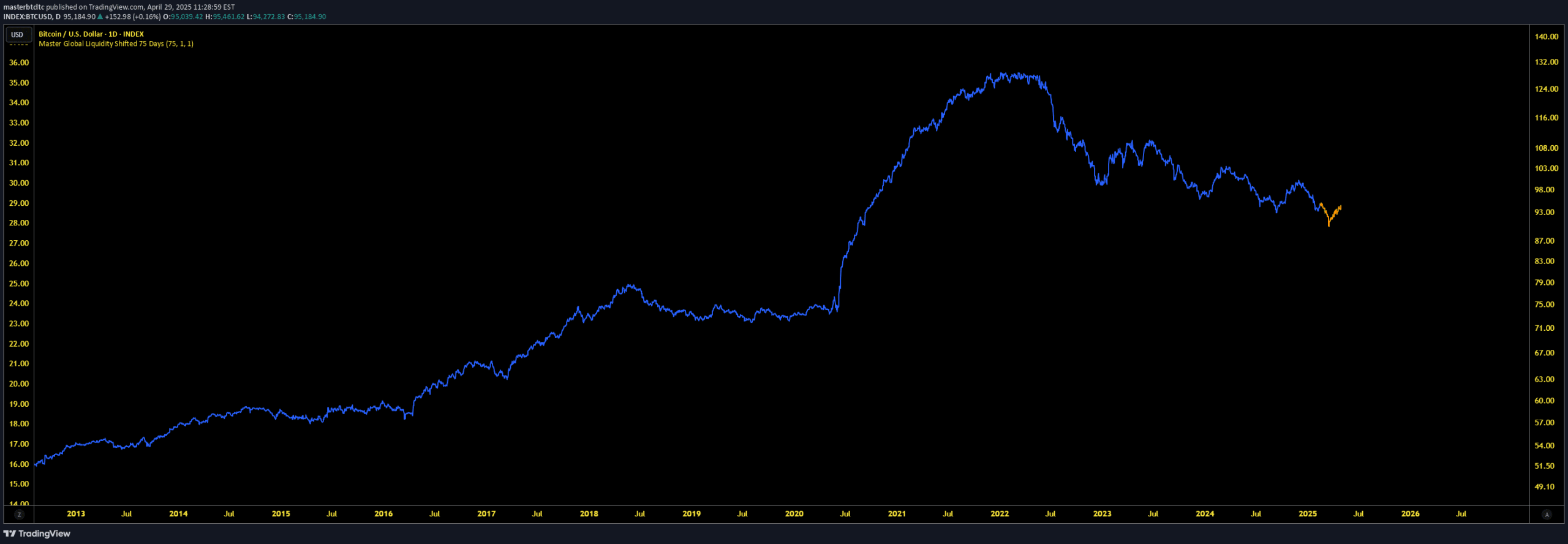
A technical indicator that measures global financial liquidity by aggregating central bank balance sheet data and money supply metrics, providing insights into broader economic conditions.
Explore complementary indicator rolesHow it works
The Global Liquidity Index calculates total liquidity by aggregating balance sheet data from major central banks like the FED, ECB, and BOJ. It incorporates various liquidity factors including balance sheet sizes, Treasury General Account, and Reverse Repurchase Agreements.
The data is scaled by dividing by 1 trillion and processed using a Simple Moving Average and Rate of Change calculation. The indicator applies a 75-day shift to align historical liquidity data with earlier price action. Users can toggle specific liquidity components and customize calculation periods
Why it may be useful
The Global Liquidity Index provides traders with a comprehensive view of global economic conditions by tracking monetary policy and central bank activities. It helps identify potential market trends and shifts in financial liquidity across different regions.
By aggregating data from multiple central banks, the indicator offers a macro-level perspective on economic health. Traders can use this information to anticipate potential market movements, understand broader economic trends, and make more informed investment decisions
When to explore it
The Global Liquidity Index is most effective for long-term trend analysis and macro-economic strategy. It works best when analyzing broader market conditions and potential long-term investment opportunities.
Traders should use this indicator during periods of significant economic change, monetary policy shifts, or global financial transitions. It is particularly useful for swing traders and investors interested in understanding the underlying economic factors driving market movements
Keep exploring
What we’ve verified
Access, alerts and repainting behaviour have not been independently verified for this indicator. Check the creator’s current publication and settings.
General descriptions and classifications are recovered research. Verified details above identify the specific checks we have completed. Check the creator’s current publication for later changes.