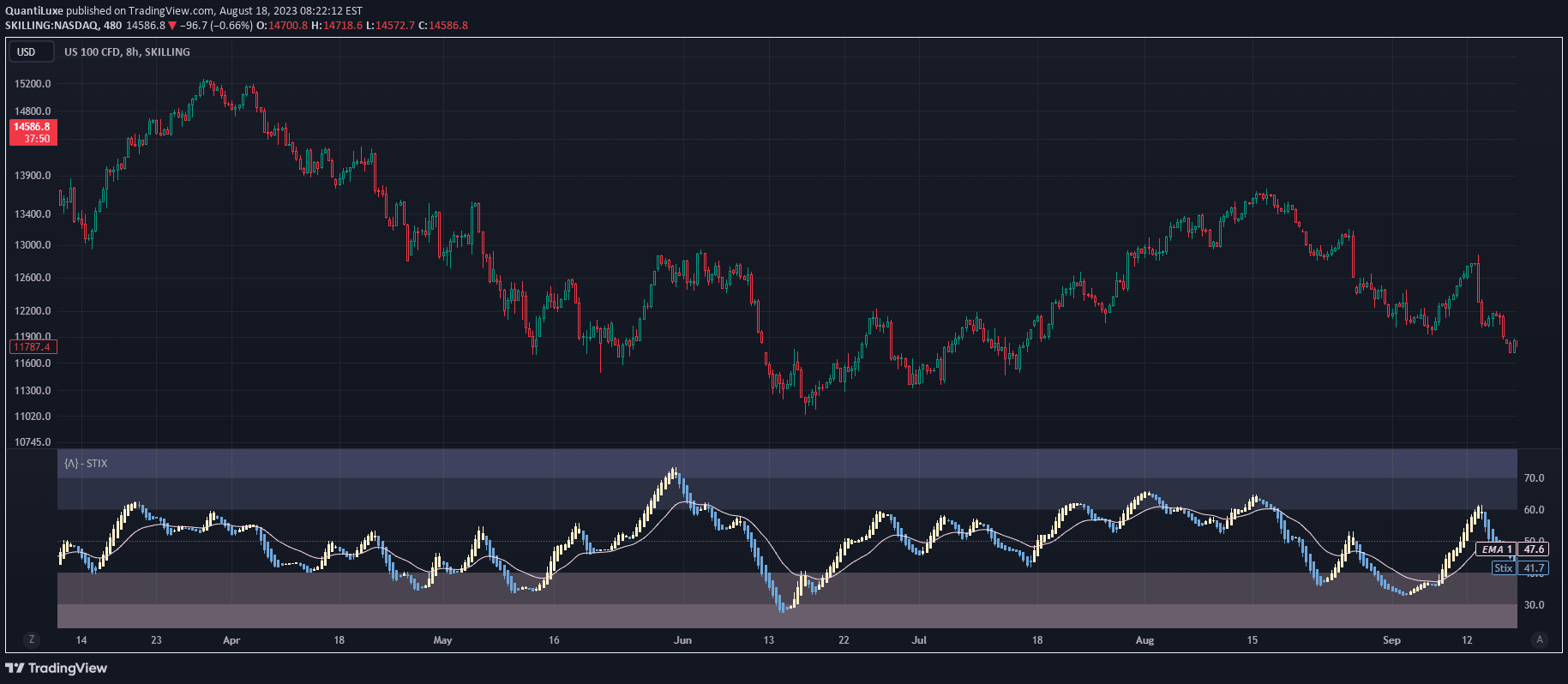
STIX is a market breadth indicator that measures advancing versus declining issues to assess short-term market sentiment and potential overbought or oversold conditions.
Explore complementary indicator rolesHow it works
The Short-Term Index (STIX) calculates market sentiment by dividing advancing issues by total traded issues and multiplying by 100. This creates a percentage-based indicator that ranges from 0 to 100, providing a clear view of market breadth and momentum.
The indicator is further refined using a Heiken-Ashi transformation, which smooths the data and reduces market noise. By applying an exponential moving average to the calculation, STIX offers a more refined and interpretable representation of short-term market dynamics.
Why it may be useful
STIX provides traders with a powerful tool to gauge market sentiment and potential trend reversals by offering a comprehensive view of market breadth. It helps investors understand the underlying strength or weakness of market movements beyond individual stock performance.
By identifying overbought and oversold conditions, STIX enables traders to make more informed decisions about market entry and exit points. The indicator's ability to smooth out market noise and provide clear signals makes it a valuable resource for understanding short-term market trends.
When to explore it
STIX is most effective during periods of high market volatility and when seeking to understand broader market sentiment across multiple issues. It works best when used in conjunction with other technical indicators to confirm potential trend changes and market reversals.
Traders should pay special attention to STIX values below 40 (indicating oversold conditions) and above 60 (indicating overbought conditions). These extreme readings can signal potential market turning points and provide valuable insights for developing trading strategies.
Keep exploring
What we’ve verified
Access, alerts and repainting behaviour have not been independently verified for this indicator. Check the creator’s current publication and settings.
General descriptions and classifications are recovered research. Verified details above identify the specific checks we have completed. Check the creator’s current publication for later changes.