Cointegration Buy and Sell Signals [EdgeTerminal]
A sophisticated statistical arbitrage tool that uses advanced mathematical techniques to detect potential market reversals by analyzing EMA relationships and statistical spread dynamics.
Explore 11,183 indicators. Filter beyond the obvious.
Discover the tools that fit the way you trade.
11,183 tools to explore
A sophisticated statistical arbitrage tool that uses advanced mathematical techniques to detect potential market reversals by analyzing EMA relationships and statistical spread dynamics.
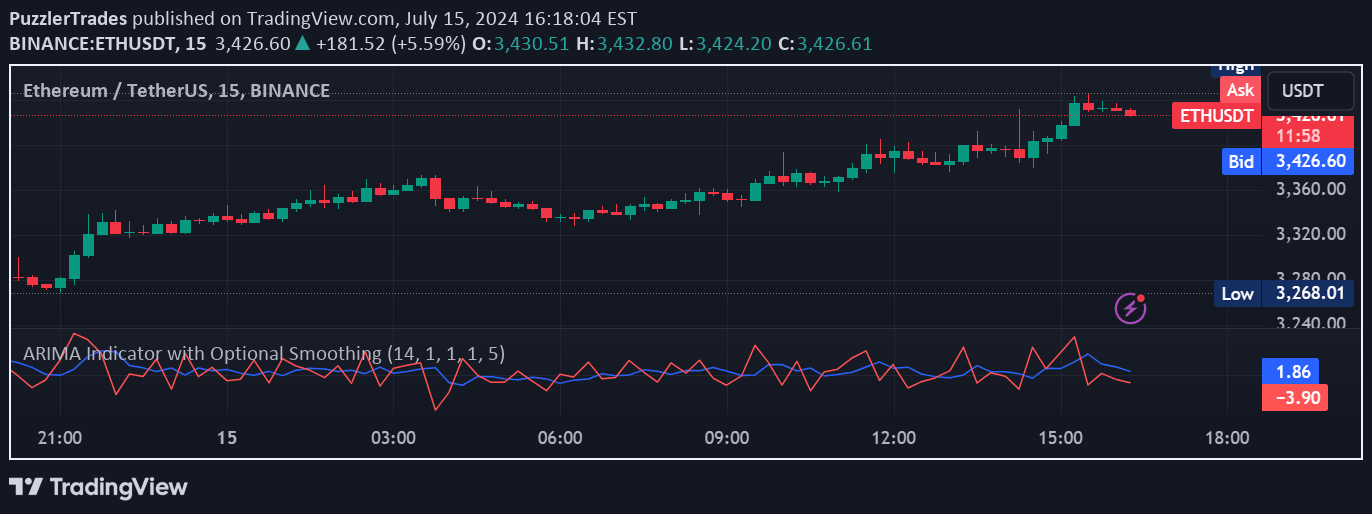
ARIMA is a time series forecasting model that analyzes historical price data to predict future price movements and provide confidence intervals for potential trend directions.
An advanced seasonality indicator that analyzes monthly trading patterns, correlation, and forecasting using machine learning principles to provide insights into potential market movements.
A statistical test that determines whether a time series is stationary or non-stationary, helping traders understand if a financial instrument tends to mean-revert or follow a trend.
A statistical model analyzing price spread between two instruments using stationarity tests and Z-score to determine potential trading signals based on market deviation.
Econometrica is a sophisticated mathematical indicator that bridges technical and fundamental analysis by creating regression models that predict ticker values using key US economic data metrics.
ARIMA Indicator forecasts price movements by analyzing historical data, combining autoregressive and moving average components to predict future trends and potential reversals.
Fractional differentiation is an advanced mathematical technique that reveals hidden market patterns by adjusting the differentiation order to balance signal clarity and data memory.
A stationarity analysis tool that examines price returns, moving averages, z-scores, and autocorrelation to identify potential changes in stock price dynamics.
Likes, views, and comments are historical TradingView snapshots. They describe attention, not trading performance.